What Does Always-On Communication Really Mean in a Busy NHS Hospital?
What Does Always-On Communication Really Mean in a Busy NHS Hospital?
19th August 2026
In a busy NHS hospital, the flow of communication never really stops. Clinical teams coordinate patient care, maintenance technicians respond to faults, security manage incidents, and operational leads balance flow across wards and departments. The phrase “always-on” communication is often used loosely, but in an acute healthcare environment it has a very specific meaning: the ability to connect instantly, reliably and without friction whenever the situation demands it.
However, always-on does not mean constant chatter. It means that the communication architecture or framework is permanently available — ready the moment someone presses a button or calls for support. In practice, this is where well-designed commercial two way radio systems and structured radio push to talk workflows come into their own. Read on to find out more.
Immediate Communication Channels
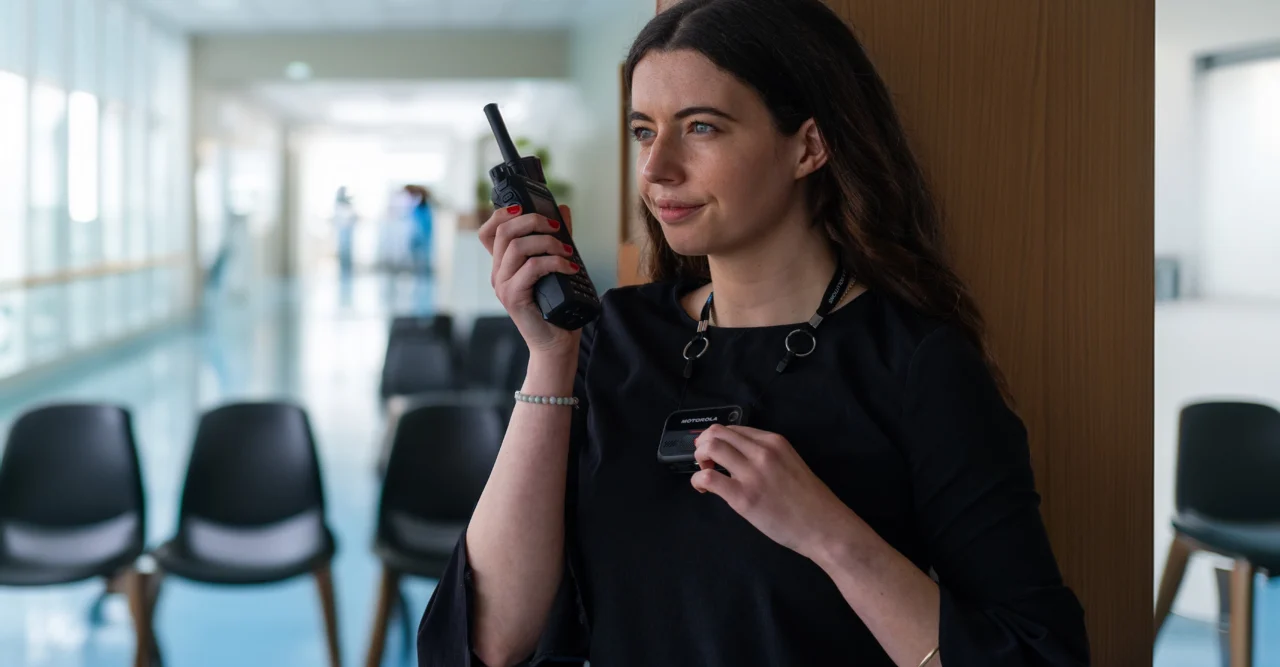
In high-pressure environments such as operating theatres or critical care units, delay creates risk. Thumbing through numbers on a smart phone or internal landline system, waiting for calls to connect, or routing through a hospital switchboard can add seconds that matter. Radio push to talk removes those steps. With a single press, staff can connect to a predefined group, whether that is security, site management, portering or a rapid response function.
The difference is subtle but significant. Instead of one-to-one conversations happening in parallel, radio enables one-to-many coordination in real time. Everyone assigned to that talkgroup receives the same message simultaneously, reducing duplication and improving clarity, and without having to depend on the vagaries of a mobile network. In operational terms, always-on means the network is ready even when users are not actively speaking.
Reliability Across Complex Estates
The thick concrete walls and labyrinthine wards and offices of a busy NHS hospital are notorious for creating mobile ‘black spots’ in which connective it is patchy at best. During peak times, mobile and 4G/5G networks may also experience congestion. Commercial two way radio systems are engineered differently to smartphones. They operate on a dedicated, licensed spectrum and are designed around the physical footprint of the hospital estate. Coverage planning focuses on the areas where your staff actually work — including those hard-to-reach spaces where estates teams and security officers are often deployed. Always-on, in this context, means confidence that communication will function consistently across the site, not just in open wards or administrative offices.
Structured Communication Under Pressure
Pressure in a hospital is rarely confined to one department. A surge in A&E arrivals, for example, can affect bed management, portering, site teams and security almost simultaneously. In these moments, the challenge is less about making contact with such and such colleague and more about maintaining the operational flow across multiple moving parts. An always-on radio environment allows operational leads to maintain live oversight of developing situations, reallocating resources in real time as priorities shift. So instead of reacting in isolation, teams can hear the wider context — understanding not just what is happening in their immediate area, but how it connects to pressures elsewhere in the hospital. That broader situational awareness is what enables hospitals to stay coordinated during sustained periods of intensity, rather than simply responding to one issue at a time.
Find Out More
To explore how resilient, always-on communication can support your hospital environment, speak to one of the experts at CSE Crosscom about tailored commercial two way radio systems built on Motorola Solutions technology. From system design and coverage planning to device rollout and long-term support, CSE helps NHS Trusts implement robust radio push to talk solutions that strengthen safety, coordination and operational control across their entire estate.
When pressure builds in a busy NHS hospital, communication can’t be left to chance. Our new article breaks down what “always-on” communication actually looks like on the ground, and why purpose-built commercial two way radio systems and structured radio push to talk workflows are critical to safe, coordinated care.