Reimagining Safety in Healthcare: How Connected Communication Is Empowering Clinical and Security Teams
Reimagining Safety in Healthcare: How Connected Communication Is Empowering Clinical and Security Teams
14th August 2026
Healthcare has always been a high-pressure environment, but across the UK, the combination of rising demand, stretched estates, and more frequent incidents of aggression has pushed safety to the top of the operational agenda — not only in A&E, but across wards, community settings, mental health services and ambulance handover points.
Recent national reporting has been stark. NHS England noted that 14.38% of NHS staff experienced physical violence in 2024, up from 13.88% in 2023, based on the most recent NHS Staff Survey. Meanwhile, the Royal College of Nursing has continued to call attention to the reality many frontline teams face, describing severe abuse and threats experienced by staff, particularly in emergency care.
So, what does “safety reimagined” look like in the NHS?
To start with, it isn’t a single product or policy. Rather, it is an operating model in which clinical teams, security, porters, estates, and switchboard/operations teams can coordinate instantly, share the right information at the right moment, and escalate issues without delay — using connected, resilient communications that work across multiple buildings, sites and devices.
That’s why push-to-talk radio communication and broadband push-to-talk are increasingly being deployed as a practical, day-to-day safety enabler in many NHS hospitals.
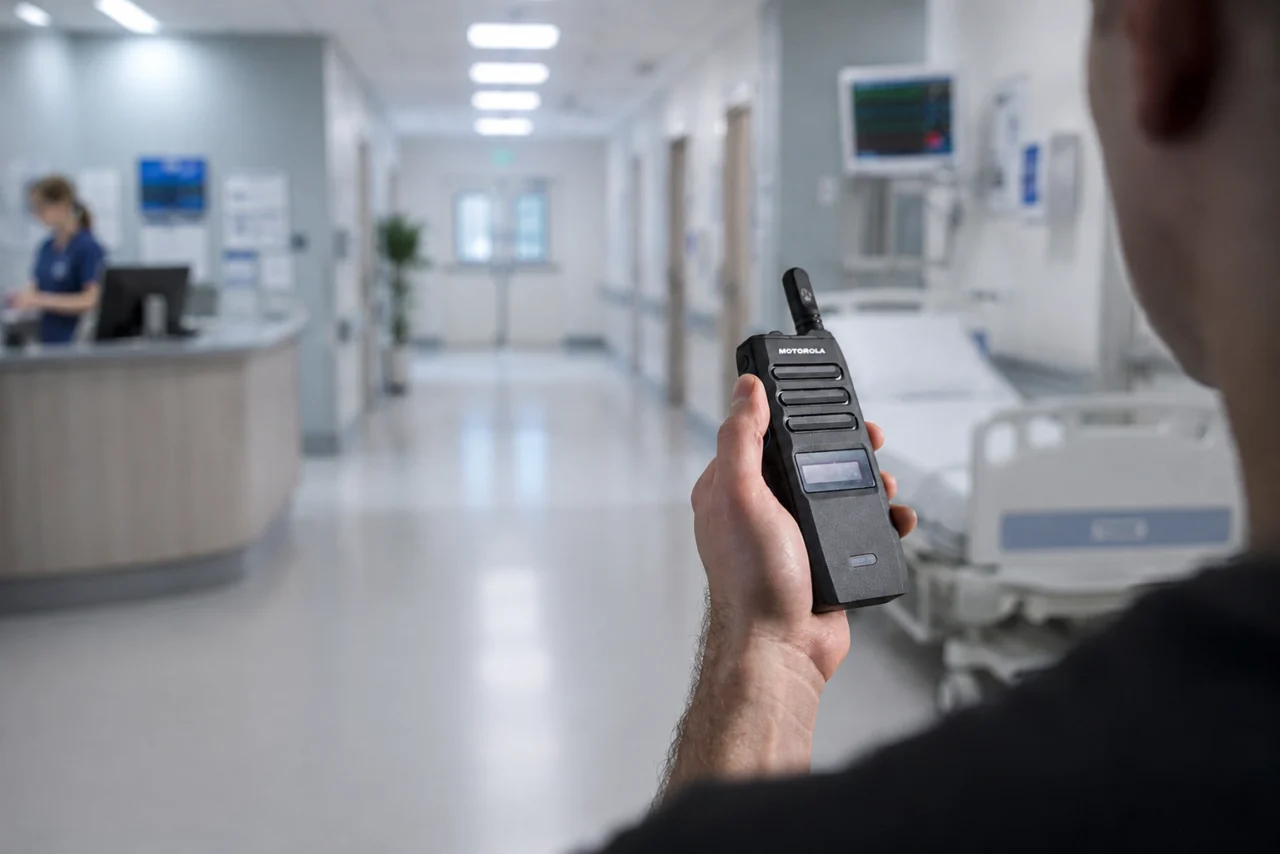
The Risk Profile In Modern Hospitals
In a hospital, risk doesn’t usually arrive neatly packaged, and a single incident can touch multiple teams. For example:
- A deteriorating patient on a ward triggers a clinical response — and sometimes a request for security support if relatives become distressed or aggressive.
- A missing patient requires coordination between nursing staff, site management, security and potentially the police.
- An estates alarm needs an immediate check to protect critical infrastructure.
- A crowded A&E waiting room needs calm, coordinated de-escalation and a fast route to additional support.
The challenge isn’t that people aren’t willing or able to support their colleagues. It’s that information and response capability can be fragmented: different teams on different systems, calls routed through busy switchboards, and escalation relying on whoever happens to be nearest. Connected communication systems close that gap by making it normal — not exceptional — for the right people to be reachable immediately.
Motorola Safety Reimagined In Healthcare: From Devices To Outcomes
The Motorola Solutions’ “Solving for Safer” narrative is built around connecting technologies that help protect people and places. In the NHS and other healthcare environments, that translates into an ecosystem mindset:
- Reliable voice for instant coordination (the foundation)
- Broadband push-to-talk to extend teams beyond radio coverage and across multiple sites
- The ability to share richer context (text, photos, location, incident details) when appropriate
For many Trusts, the most immediate safety uplift comes from modernising their day-to-day communications: making it easier for clinical and security teams to coordinate, and harder for an urgent call for support to get stuck in a queue.
Why Push-To-Talk Still Matters In A Smartphone World
Modern hospitals are noisy and complex environments. When something goes wrong and help is required, people don’t need another app notification — they need instant, confident contact.
Push-to-talk is designed for exactly that:
- One-touch connection to an individual or a ‘talkgroup’ (e.g., “A&E Triage’”, “Security Rapid Response”, “Cleaning Team”)
- Hands-busy, eyes-busy usability, including with gloves and in motion
- Speed under stress — no dialling, no hunting for numbers
And importantly, broadband push-to-talk platforms (such as Motorola’s WAVE PTX) are explicitly built to connect scattered teams using diverse devices, networks and locations, blending the simplicity of radio-style PTT with the fire sharing flexibility of smartphone communication (text, photo, video, file attachments etc).
In practice, that means an NHS Trust can support the communication and safety needs of a mixed estate, tailoring it’s support strategy to the pressures and challenges faced by its key stakeholders.
- Unified operational picture: Clinical, security and facilities teams can reach each other quickly, with agreed talkgroups and escalation routes.
- Resilience by design: Coverage planning, fallback options, and device strategies that work in basements, stairwells, car parks and across multiple buildings.
- Right device, right role: Radios where durability and instant group voice are essential; broadband push-to-talk where mobility, multi-site working or richer information sharing adds value.
- Simple governance: Clear rules of use, training, and an approach that fits with information governance requirements.
What Next?
If you’d like to find out more about Motorola Safety Reimagined and how it can improve safety in a clinical health care or hospital environment, please contact CSE Crosscom today by clicking here.
The health and safety landscape is evolving in NHS Trusts, and communication technology is at the centre of this shift. In our latest blog, we explore how Motorola Safety Reimagined is supporting NHS Trusts with connected, resilient push-to-talk radio communication — enabling clinical, security and facilities teams to coordinate instantly when it matters most.